
JAWS author’s scathing letter to film's producer David Brown
The production of Jaws was famously fraught with difficulties. Filming off the coast of Martha’s Vineyard presented Steven Spielberg and his crew with unpredictable weather, challenging ocean conditions and a mechanical shark that repeatedly malfunctioned, pushing the production over schedule and budget. As the screenplay evolved under the pressures of a demanding shoot, creative decisions and changes to the story inevitably prompted questions and concerns from Peter Benchley, whose novel had inspired the film. Communications between Benchley and producer David Brown provided a channel for the author to voice his thoughts, challenge certain creative choices and offer suggestions, even as the film increasingly became Spielberg’s own artistic vision. Against this backdrop, Benchley’s letter offers a fascinating snapshot of the creative tensions, candid exchanges and mutual respect that shaped one of cinema’s most enduring thrillers.
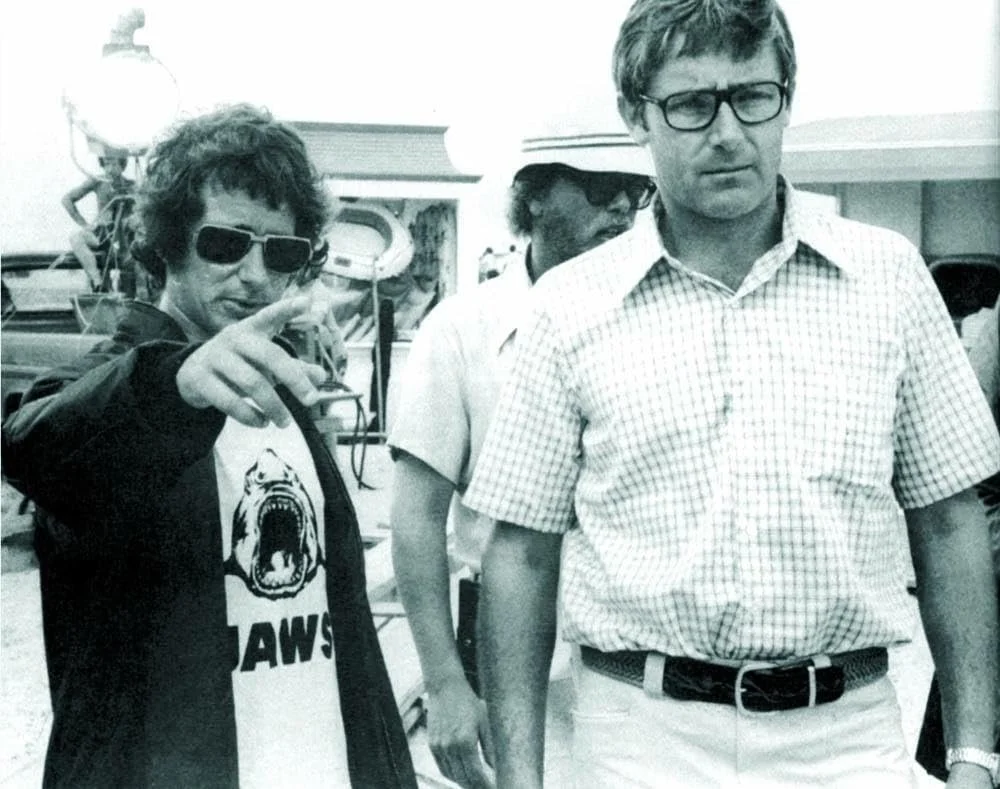
Peter Benchley on location with Steven Spielberg (right)
Peter Benchley’s letters were often peppered with humour, facetious asides and a healthy dose of wit. His relationship with Jaws producer David Brown was built on mutual trust, allowing the two men to communicate with refreshing honesty. Benchley once described Brown as “one of the most gracious, kindly, generous and thoughtful producers ever to work in the fetid swamps of Hollywood.”
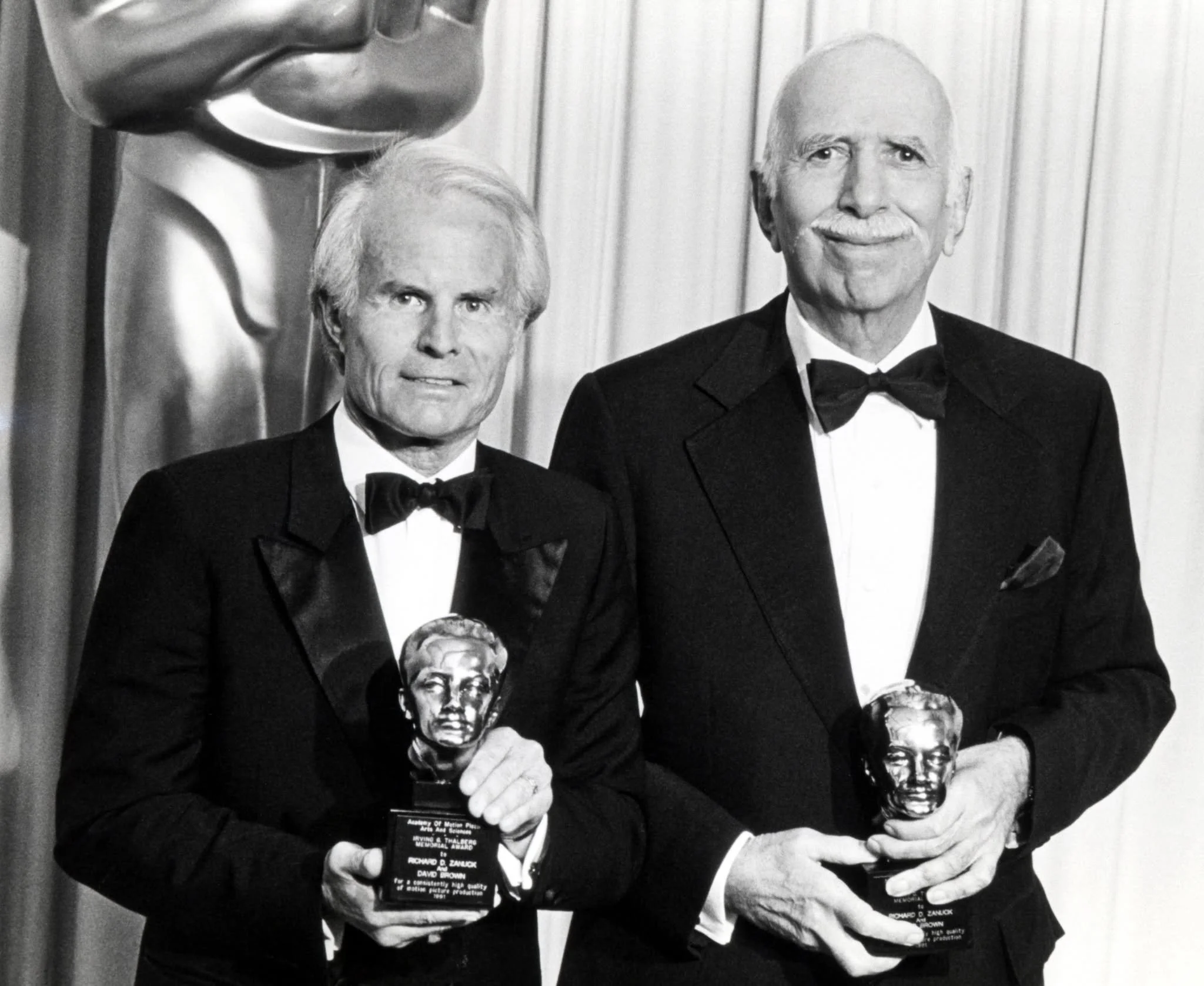
JAWS producers Richard Zanuck and David Brown (right)
When Brown asked Benchley for his candid feedback on drafts of the Jaws screenplay, the author didn’t hold back. In the following letter, Benchley outlines his concerns about several aspects of the script, from the controversial “rogue shark” concept to character inconsistencies and scientific inaccuracies. His criticism is pointed, occasionally scathing, but interspersed with the dry humour and playful remarks that characterised their correspondence.
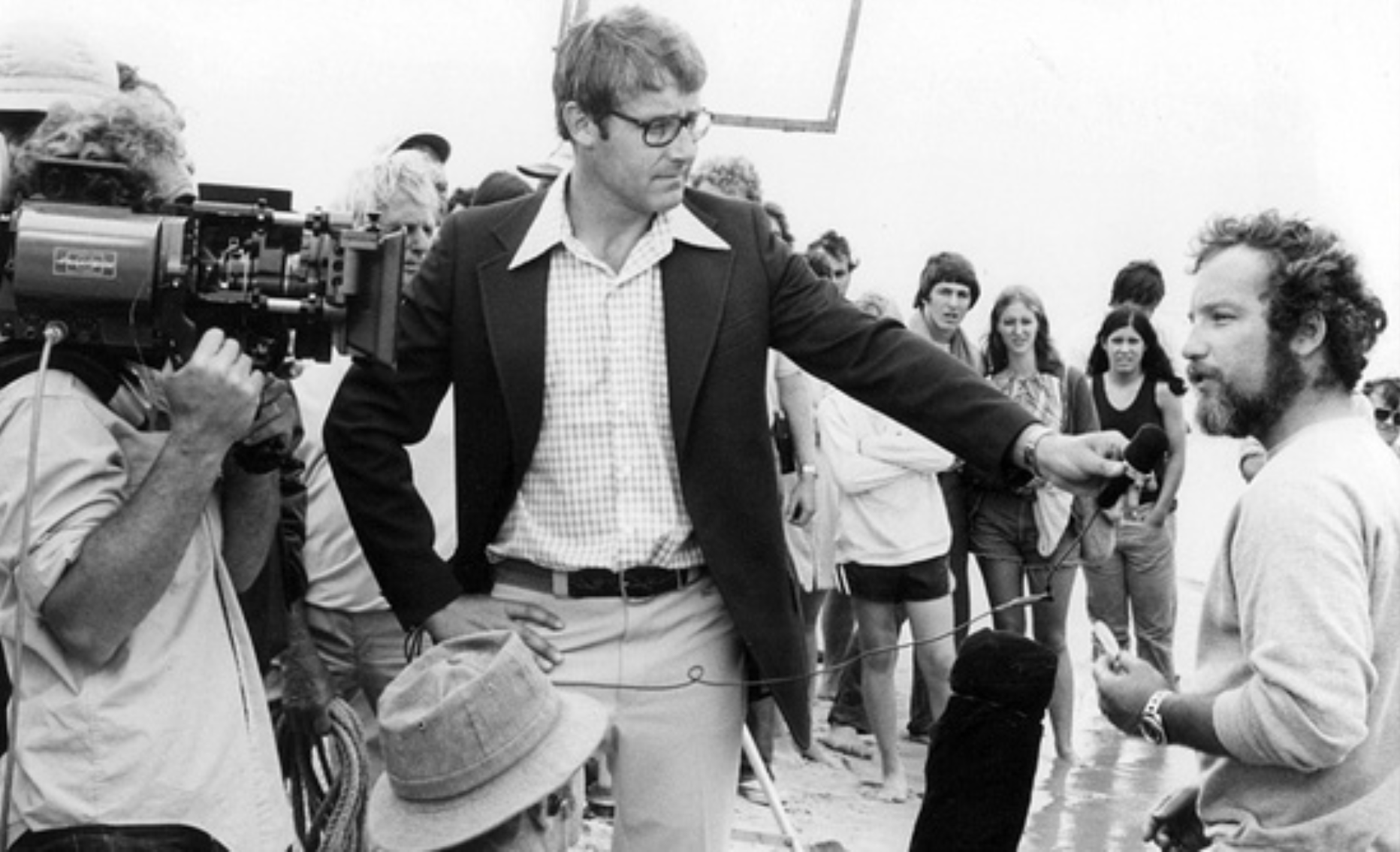
Peter Benchley cameoing as a reporter, imnerviews Richard Dreyfuss in an unused scene from JAWS
Yet, beneath the criticism lies a genuine affection for Brown and an appreciation of the filmmaking process. Benchley understood that a film ultimately belonged to its director, and he recognised the extraordinary contribution Steven Spielberg’s vision and talent had made to his story. Even his closing quip about being “angry” — prompted by a newspaper clipping that apparently misstated the film’s release date — was delivered with a wink, rather than genuine resentment.
This fascinating letter offers a rare glimpse into Benchley’s creative concerns, his relationship with the people bringing Jaws to the screen, and the humour that helped keep their working relationship on such good terms.
“Dear David:
As I mentioned on the phone this morning, I am deeply troubled by some things in the final draft screenplay of “Jaws.” I fear that if they were ever to appear on the screen, the picture would be hooted at—not just by shark-freaks, but by general audiences, too—as an insane farce. Furthermore, I think they detract for the suspense of the film.
I have several other, less important, reservations, and I’ll mention them in descending order of concern.
First and most critical of all is the “rogue shark” concept. You said that Steve apparently consulted some authority before taking this new tack. I, too, have consulted authorities, and my sources agree with me that the concept is totally absurd. I’ll be glad to argue specics any time, but rather than write you a thesis here and now, I’d prefer to oer one artistic argument against the rogue-shark thing: if you present this shark as a world-girdling maniac, responsible for nearly every recorded shark-attack death, you destroy one of the central horrors of the story—namely that a shark doesn’t have to be deranged to eat people. Eating people is normal, instinctual behavior for great white sharks. There is profound terror in the normalcy of killing.
Also, to have Hooper claim to have tagged this shark reduces its menace and mystery. It makes the shark approachable and familiar. That leads me to Hooper, who, in general, strikes me as an insuerable, pedantic little schmuck—not only pedantic, but ignorantly so, since many of the things he says about sharks are either misleading or atly wrong. He sounds like a textbook full of errors. Again, I’ll cite chapter and verse to anyone who cares to listen.
Now, on to a few specic things that bothered me. I have tried to avoid picking nits (things like the horseshoe crabs). And the things that trouble me least (which you may well consider nits) I’ve saved for last.
Ellen’s gimmick with the travel brochures seems phony as hell. First of all, it’s a terrible cliche. Second, if she’s married to Brody, she should realize what his position is. She comes over as a nag, and since she vanishes almost immediately, we’re left with a vague, unresolved sense that Brody has an unhappy marriage.
P. 13—Meadows’ speech about sharks and their swim bladders is wrong. He’s mixing apples and oranges, and he compounds the felony by saying, “Don’t you know anything about them?”
P. 40—Hooper would never be suckered into believing that a ten- foot blue shark killed those people. Never.
P. 44—Brody seems here to be disbelieving the blue-shark theory.
When did he change his mind?
P. 48—And when did Hooper suddenly change his mind about the blue shark as a possible killer?
P. 55—Hooper claims to have seen the white shark before, and at close range. So how come he says it’s only 17 feet long?
P. 65—Hooper says of the shark, “It knows where you live.” He is anthropomorphizing, something that he would be the first to argue against. God, he’s an inconsistent character!
P. 78—What suddenly changes Brody from a man terrified of the water to a man eager to join Quint? I remember discussing this change-of-heart at great length. It seems to have been resolved by ignoring it.
The following are relatively minor:
P. 5—The bloody billboard is still there, I see. I feebly repeat that it is way out of character for the town.
P. 23—Someone named Denherder makes a reference to a sporting charter on Valentine’s Day. I know of no one on the East Coast who would go fishing on February 14th, for, among other reasons, there are no game sh around on February 14th.
P. 24—Brody says, “But nobody sport-shes for sharks!” If this is intended to make him seem stupid, it succeeds. If it is meant as a fact, it is wrong.
P. 30—If Hooper is a diver, he’s unlikely to be bearded. Beards get in the way. Bearded divers exist, of course, but why even raise the question in the audience’s mind?
P. 35—This, I admit, is a nit, but I’ll pick it anyway. Here and onthe following page it is clear that Steve doesn’t know guns. Fine. I assume there will be someone on location who will know that, for instance, a .30 caliber rie doesn’t re a ‘wad’ and couldn’t ruin rigging.
P. 76—Hooper refers to Ipswitch, Maine. There may be an Ipswitch, Maine, but a more familiar Ipswich is in Massachusetts.
There you have it. I am aware that 1) lm is a directors’ medium, 2) my part in the entertainment has long since technically ended, and 3) you may well decide to make this letter into a paper airplane and skim it o the top of the Tower. But I did want to convey these points, if only to vent my spleen.
As I have said (and said, and said), I would be willing—nay, eager—to meet and work with Steve, should he deem it helpful.
Yrs,
Peter Benchley
PS/ What makes me angriest of all is that you didn’t tell me you had already made and released the movie of “Jaws.” I had to find out from the clipping I’ve appended below.”
If you would like to write for The Daily Jaws, please visit our ‘work with us’ page
For all the latest Jaws, shark and shark movie news, follow The Daily Jaws on Instagram, Twitter and Facebook.