
Beyond the JAWS: The story behind MarineCreatures.com
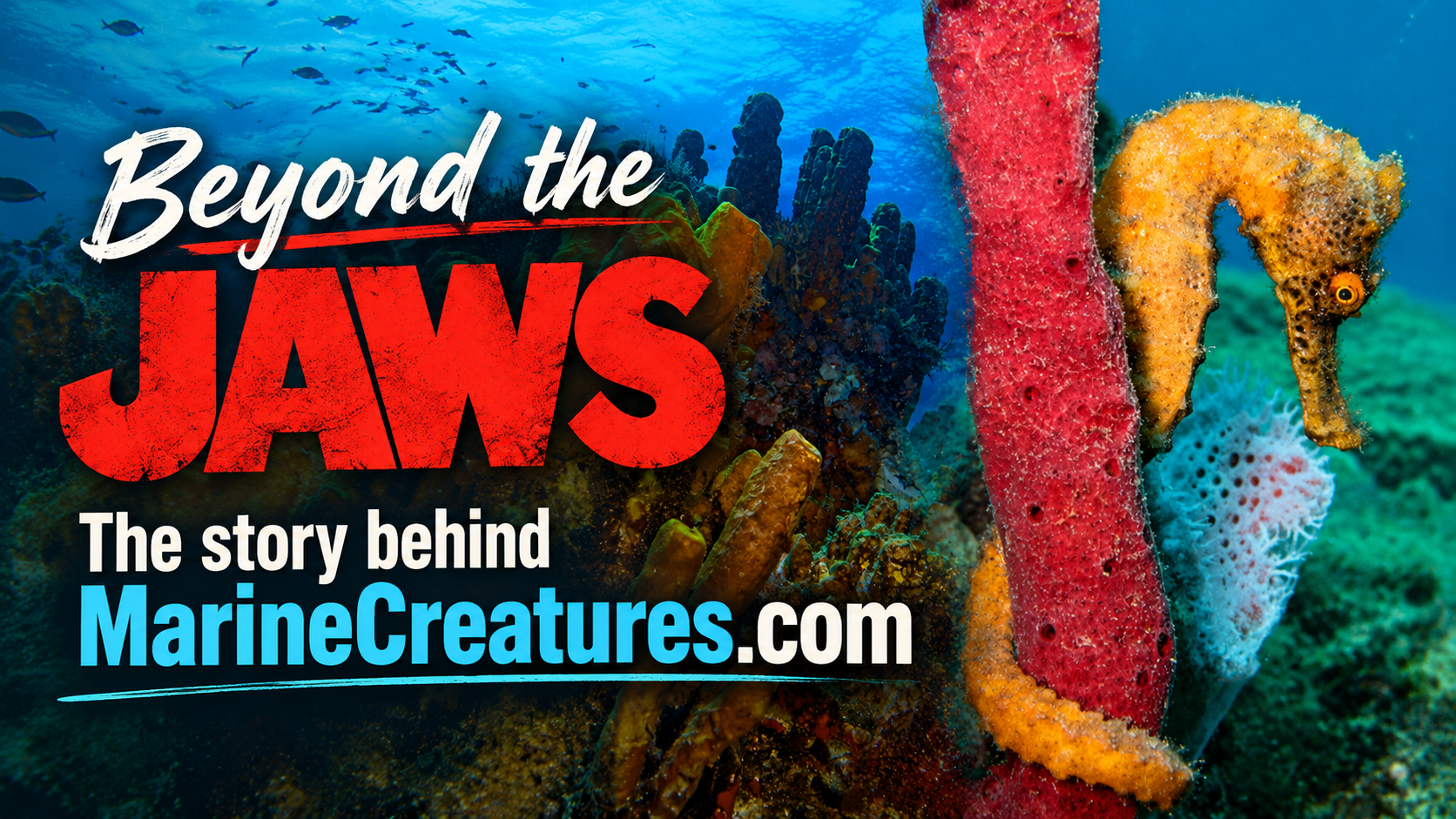
There is probably no better way of explaining my relationship with sharks than to say that, like so many people of my generation, Jaws was somewhere in the background of my childhood. But there was a difference. I didn't grow up wanting to stay on the beach because of the shark. I wanted to get in the water.
That curiosity eventually became a career, and more than three decades later I have spent much of my life exploring, studying, photographing and working with marine life in oceans and coastal environments around the world. That journey is what MarineCreatures.com is really about.
It is not simply a website about sharks. And it isn't intended to be another collection of beautiful underwater photographs without a story behind them. It is my personal field archive — a place where I can bring together more than 30 years of marine biology, marine ecology, conservation, research, fieldwork, photography and some of the extraordinary encounters that have shaped my life beneath the surface. And yes, there are quite a few sharks.
It started with a fascination with the ocean I've always been fascinated by what lies beneath the surface. The more time I spent underwater, the more I realised how little most of us ever see of the marine world. We see the ocean from the shoreline, perhaps from a boat or on holiday, but underneath is an entirely different planet.
That fascination led me into marine biology and, eventually, into a career that has taken me across more than 22 countries and through an extraordinary variety of marine environments. I've worked on marine conservation projects, ecological surveys, environmental impact assessment, marine mammals, endangered species, marine plastics, offshore renewable energy, biodiversity and marine research.
I've worked with governments, ports, conservation organisations, environmental regulators and developers. But alongside that professional career, I've always carried a camera.
The photographs and stories on MarineCreatures.com are therefore not simply images I've collected from around the world. They are records of places I've been, species I've encountered, people I've worked with and experiences that, in many cases, happened decades ago.
And then there are the sharks... Sharks have always held a particular fascination for me. Perhaps that's partly Jaws. Steven Spielberg's film undoubtedly changed the way an entire generation thought about sharks. It also created a mythology around these animals that has proved remarkably difficult to shake.
But spending time around real sharks has a way of changing your perspective. The great white that appears terrifying on a cinema screen becomes something rather different when you are observing it in its natural environment. I've been fortunate enough to encounter great whites in South Africa and nurse sharks in Belize, among many other shark encounters over the years.
One of the most memorable was my 2008 trip to Gansbaai, South Africa, where a lifelong ambition finally became reality: getting close to great white sharks at Seal Island.
At one point, a large great white surged towards the cage, its head and jaws coming right up against the bars. It was an extraordinary moment. And yes — standing inside a cage while a great white investigates you does make you think about Jaws. But the experience also reinforces something important: these are wild animals, not movie villains. The more you understand sharks, the more fascinating they become.
That is one of the things I hope MarineCreatures.com can do — replace some of the mythology with curiosity, knowledge and respect. A website built from a lifetime of experience MarineCreatures.com has evolved considerably.
What began as a way of bringing together photographs and memories has developed into something much broader: a living archive of my career in marine science. The site now brings together species information, field stories, photography, research, conservation work, professional experience, expeditions, video and educational material.
There are stories from Dominica, the Caribbean, the Philippines, Mexico, South Africa, Belize, Egypt, Ireland and many other places. There are sea turtles, dolphins, whales, rays, dugongs, jellyfish, coral reefs and countless fish. And, naturally, sharks. But the common thread is always the same:
Explore. Understand. Protect.
That is the philosophy behind the site. The stories behind the photograph. One of the parts of MarineCreatures.com that means the most to me is the growing collection of personal stories. A photograph can show you what something looked like. A story can tell you why it mattered.
I've been lucky enough to experience some extraordinary things during my career. In Dominica, I worked with the Rosalie Sea Turtle Initiative and spent years involved with leatherback turtle conservation. I've encountered manta rays in the Gulf of California, worked around marine mammals, explored coral reefs and witnessed the realities of marine pollution. Some experiences were exciting. Some were difficult. Some were simply funny. And some stayed with me for decades.
I'm now putting those experiences down properly — including the places, dates, people, species, photographs and circumstances surrounding them. It's important to me that these aren't polished travel stories pretending that everything was perfect. They're field stories. They're personal recollections from a life spent working around the ocean. From conservation to marine plastics
The ocean isn't just about wildlife encounters. Much of my professional career has involved understanding the pressures that human activity places on marine ecosystems. I've worked in marine ecology, environmental assessment, conservation, marine plastics, biodiversity and offshore renewable energy. That is reflected throughout MarineCreatures.com.
I want the site to be a place where someone can arrive because they're fascinated by a great white shark and leave having discovered something about marine ecology, plastic pollution, sea turtle conservation, offshore wind or the importance of healthy marine habitats.
Because ultimately, these subjects are connected. You cannot properly understand a shark without understanding the ecosystem it lives in. And you cannot protect that ecosystem without understanding the pressures acting upon it.
Why build it now?
After more than 30 years working in marine science, I realised I had accumulated something rather unusual. Thousands of photographs. Field notes. Research. Published work. Stories. Video. Professional experience.
Memories of places that have changed enormously since I first visited them. And encounters with species that I never wanted to simply disappear into an old hard drive or a box of photographs. So MarineCreatures.com became a way of bringing it all together. It is part archive, part educational resource, part photographic collection and part personal history. Most importantly, it is still growing. There are decades of material to work through.
It's personal
There are plenty of excellent marine-life websites on the internet. MarineCreatures.com isn't trying to compete with all of them. What makes it different is that it is fundamentally first-hand. When I write about a particular encounter, expedition or conservation project, I'm not simply repeating something I've read elsewhere. I was there. I saw it. I photographed it. I worked on it.
Or, where something comes from published research or another authoritative source, I want that distinction to be clear too. That matters to me. After a lifetime in science and environmental consultancy, credibility is important. So is honesty.
The site brings together my professional background as a marine biologist and marine ecologist with the much more personal side of my life — the fascination, the photography, the diving, the exploration and the sheer enjoyment of being underwater. The ocean is the real story
Ultimately, MarineCreatures.com isn't really about me. I'm simply the person telling the stories. The real subject is the ocean. It's the great white moving silently through blue water. The leatherback emerging from the Caribbean surf. The manta ray gliding overhead. The dolphin travelling through open ocean. The coral reef supporting hundreds of species. The tiny plastic fragment that shouldn't be there. The field researcher sitting on a beach at two in the morning waiting for a turtle to emerge.
Those are the stories I want to tell. Some are scientific. Some are historical. Some are conservation stories. Some are simply moments that I was lucky enough to witness. And some involve sharks. Quite a lot of sharks.
So, should you be afraid?
Well, after everything Jaws taught us, perhaps the better question is whether we should be afraid of the things we don't understand. My answer is no. We should understand them. Sharks have survived for hundreds of millions of years. They occupy hugely important positions within marine ecosystems and are far more complex and fascinating than the caricature created by popular culture.
The irony is that Jaws helped make sharks famous, but perhaps the next chapter should be about getting to know them properly. That's what I'm hoping MarineCreatures.com can contribute. Not fear. Not sensationalism. Just better understanding.
Because once you've spent enough time beneath the surface, you realise something rather wonderful: We're not the most interesting creatures in the ocean. Not even close. And thankfully, we're not the only ones.
Explore MarineCreatures.com
MarineCreatures.com is Rowan Byrne's personal archive of more than 30 years of marine biology, marine ecology, conservation, fieldwork, research and underwater photography across more than 22 countries.
You can explore the site through the following starting points:
MarineCreatures.com — the main archive
Explore the full collection of marine species, stories, research, photography and fieldwork.
About Rowan Byrne
The story behind the person, career and experience that sit behind MarineCreatures.com.
Professional Experience
More than three decades of marine biology, ecology, conservation, environmental consultancy and scientific work.
Sharks
Explore the biology, behaviour and conservation of some of the ocean's most extraordinary predators.
Stories from the Field
Personal first-hand accounts from a lifetime working around the world's oceans.
Global Expeditions
Explore the countries, projects and marine environments that have shaped my career.
Photography
A growing archive of original underwater and marine wildlife photography.
Research & Publications
Explore my published research and scientific work. MarineCreatures.com is a work in progress — deliberately so. There are still photographs to scan, stories to write, memories to reconstruct and experiences to put into context. After more than 30 years, I don't think I'm finished exploring. And if Jaws taught me anything, it's probably this: Never underestimate what might be waiting beneath the surface. But these days, I'm much more interested in finding out what it actually is.