
The JAWS Rule: Movies that keep the monster hidden for maximum fear
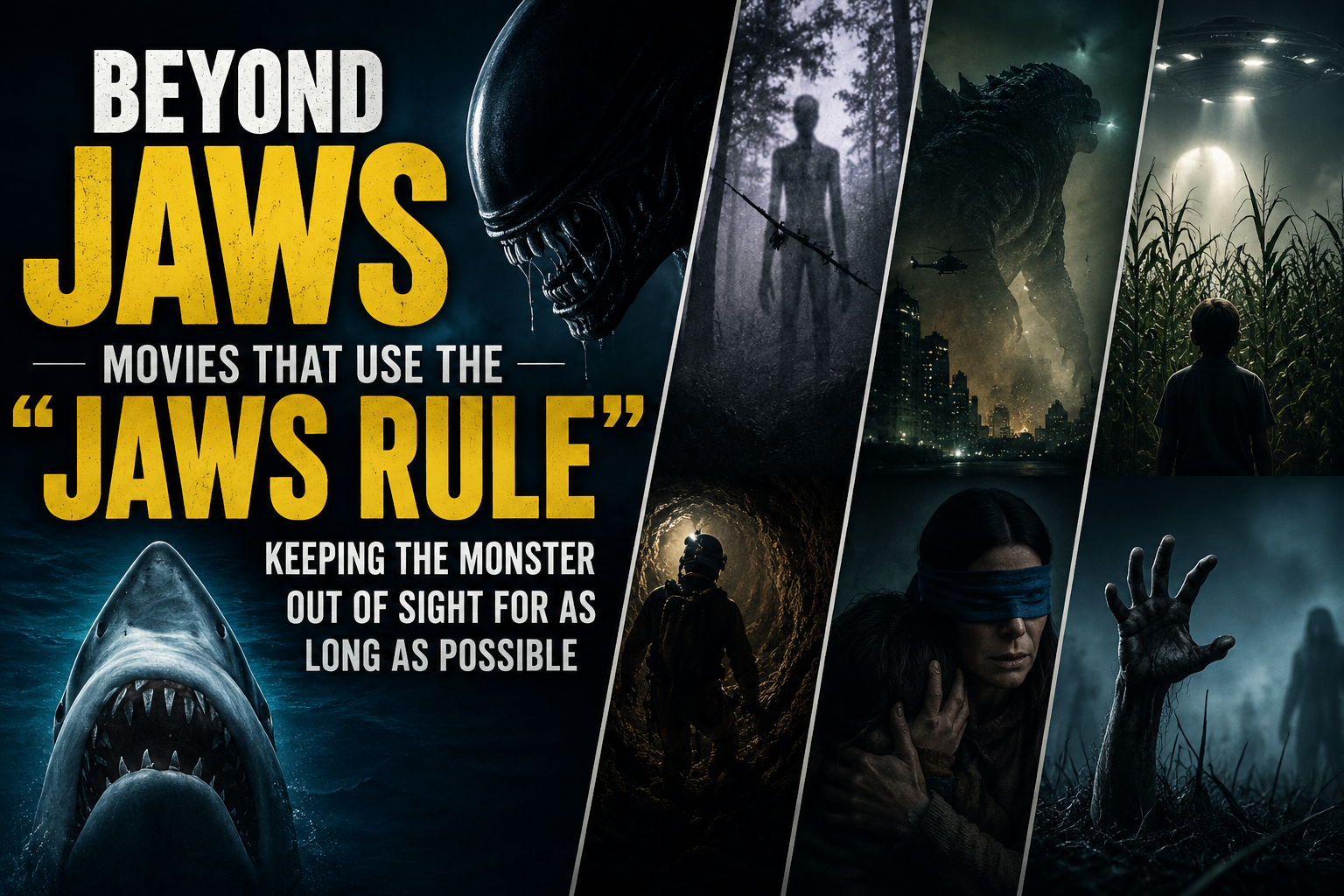
When Steven Spielberg's Jaws premiered in 1975, it changed blockbuster cinema forever. It also accidentally created one of horror's most effective storytelling techniques.
Because the mechanical shark frequently malfunctioned during production, Spielberg was forced to show far less of the creature than originally planned. The result was a masterclass in suspense. Audiences spent most of the film imagining the shark rather than seeing it, and their imaginations proved far more terrifying than any special effect.
This approach became known informally as the "Jaws rule": keep the monster hidden for as long as possible, revealing it only when the story has extracted every ounce of tension from anticipation. Many filmmakers have embraced this principle, creating some of the most memorable horror and thriller films ever made.
Alien (1979)
If Jaws perfected the hidden-monster formula in the ocean, Alien transferred it to outer space.
Director Ridley Scott reveals only fleeting glimpses of the Xenomorph for much of the movie. Shadows, strange sounds, and brief flashes of its silhouette dominate the early acts. The audience knows the creature is somewhere aboard the Nostromo, but rarely gets a clear look at it.
The strategy transforms the spaceship into a haunted house and turns every corridor into a source of dread.
The Blair Witch Project (1999)
One of the most extreme examples of the Jaws rule is The Blair Witch Project.
The titular witch never appears on screen. Not once.
Instead, viewers encounter unsettling noises, strange stick figures hanging from trees, and the growing terror of the characters. The film demonstrates that a monster can be terrifying even when it exists entirely in the audience's imagination.
Cloverfield (2008)
For much of Cloverfield, the giant creature attacking New York City remains partially obscured by smoke, darkness, collapsing buildings, and the limitations of the handheld-camera perspective.
The audience catches only fragments of the monster before finally receiving a fuller reveal. This slow unveiling helps maintain mystery despite the creature's enormous size.
Signs (2002)
Director M. Night Shyamalan understood that alien invasions are often scarier when the invaders remain mostly unseen.
In Signs, viewers spend much of the movie seeing only hints of extraterrestrials: a figure standing on a rooftop, a shadow moving through a cornfield, or the famous fleeting appearance during a news broadcast. The restraint makes each glimpse unforgettable.
It Follows (2014)
The entity in It Follows is almost always visible, yet still hidden in a psychological sense.
The monster can look like anyone and often appears in the background of scenes, slowly walking toward its victim. The audience is forced to constantly scan the frame, unsure who or what constitutes the threat. The film weaponizes uncertainty rather than concealment alone.
A Quiet Place (2018)
For much of A Quiet Place, the sound-sensitive creatures remain mysterious.
Early scenes focus on the survivors' behavior rather than the monsters themselves. We learn the rules of the creatures before we fully understand their appearance. By delaying the reveal, the film ensures that viewers fear what they hear long before they see it.
The Descent (2005)
The first half of The Descent barely features monsters at all.
Instead, the film builds tension through claustrophobia and the terrifying cave environment. When the humanoid creatures finally appear, the audience is already emotionally exhausted, making the reveal even more effective.
Watch our JAWS 50th anniversary interview with ‘The Descent’ director Neil Marshall
Bird Box (2018)
Like The Blair Witch Project, Bird Box pushes the concept to an unusual extreme.
The creatures are never clearly shown because looking at them causes people to commit suicide. The audience experiences the mystery exactly as the characters do, relying on reactions and implications rather than direct observation.
Nope (2022)
Jordan Peele builds much of Nope around uncertainty.
The film initially presents its threat as a conventional UFO. Only gradually does it reveal the true nature of the creature. Each new piece of information changes the audience's understanding, proving that delayed revelation can be as important as delayed visibility.
Tremors (1990)
The subterranean monsters in Tremors spend much of the movie underground and out of sight.
The audience sees evidence of their existence long before getting a complete look at them. Vibrations, disappearing victims, and sudden attacks create suspense while the creatures remain largely concealed.
Why ‘the JAWS Rule’ works
Humans are naturally afraid of the unknown. Once a monster is fully revealed, it becomes a defined object that can be analyzed and understood. Before that point, it exists as a collection of possibilities, each potentially more frightening than reality.
The most successful films following the Jaws rule understand that suspense and fear are not the same thing. Fear comes from seeing the monster. Suspense comes from waiting for it.
That is why, nearly fifty years after Jaws, filmmakers continue to hide their creatures in shadows, fog, darkness, and off-screen space. The lesson Spielberg learned from a broken mechanical shark remains one of cinema's most powerful storytelling tools: sometimes the scariest monster is the one the audience cannot quite see.
If you would like to write for The Daily Jaws, please visit our ‘work with us’ page
For all the latest Jaws, shark and shark movie news, follow The Daily Jaws on Instagram, Twitter and Facebook.