
Joe Alves at 90: The Designer Who Built the Impossible
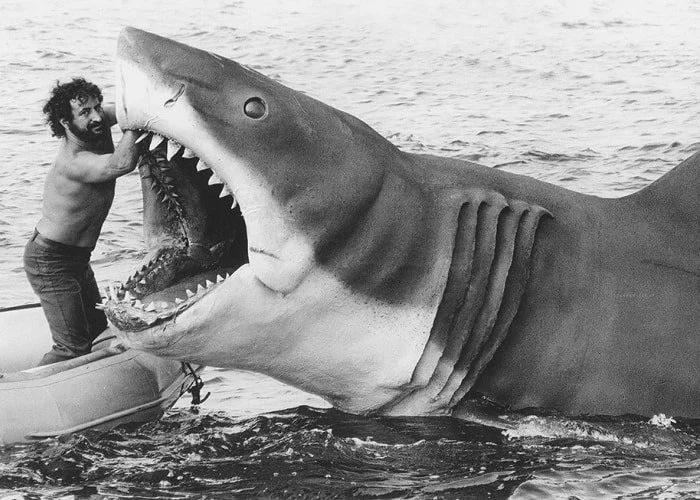
On Thursday 21 May 2026, Joe Alves turns 90 years old — a milestone worthy of celebration not only within the world of Jaws, but across the entire history of modern cinema.
For many fans, Alves will always be “the man who designed Bruce.” That alone would secure his place in film history. But reducing Alves’ career to the mechanical shark from Jaws barely scratches the surface of what he accomplished. His fingerprints are all over the DNA of the modern blockbuster: the realism of Amity Island, the eerie majesty of Close Encounters of the Third Kind, the ruined dystopia of Escape from New York, and even the strange experimental ambition of Jaws 3-D, which he directed himself.
Joe Alves did not simply decorate movies. He engineered worlds audiences believed in.
And in the case of Jaws, he helped create a film so immersive that half a century later people still hesitate before swimming in the ocean.
The First Man Hired on Jaws
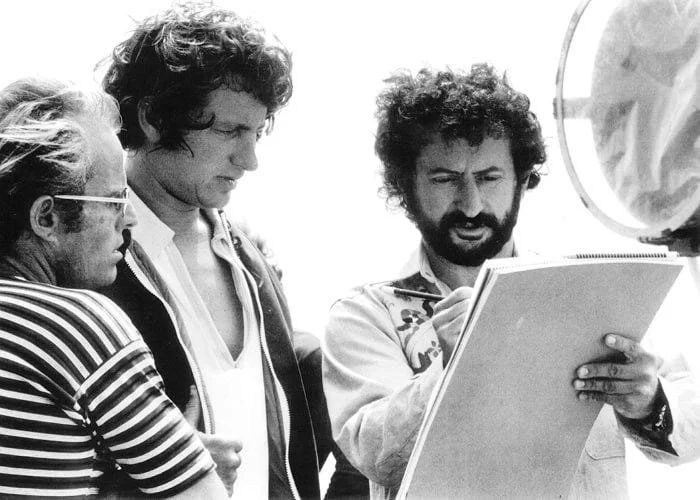
Long before audiences met Chief Brody, Quint, or Hooper, Alves was already at work visualizing Peter Benchley’s terrifying story. Producers Richard Zanuck and David Brown handed him galley pages of the unpublished novel and asked him to create illustrations that could help sell the project to the studio. (SYFY)
At that point, Steven Spielberg was not yet attached.
That detail matters because it reveals something often overlooked in the mythology of Jaws: Alves helped define the visual identity of the film before cameras rolled and before the now-legendary director fully shaped the production. When Spielberg eventually joined, the two quickly formed a creative partnership built on ambition, stubbornness, and a shared desire for realism.
Alves had already worked with Spielberg on The Sugarland Express, and the collaboration proved crucial. The pair understood that Jaws could not feel artificial. It had to look lived-in, weathered, and authentic.
That philosophy led Alves to one of the most important decisions in blockbuster history: convincing the production to shoot on the open ocean instead of a studio tank. (Architectural Digest)
The decision nearly destroyed the film.
It also made it immortal.
Finding Amity
The fictional town of Amity Island needed to feel like a genuine New England summer community — idyllic enough that audiences would mourn its corruption.
Alves scouted locations all across coastal Massachusetts searching for the right place. According to later interviews, Peter Benchley initially suggested Nantucket. But winter weather redirected Alves toward Martha’s Vineyard, where he immediately recognized the visual magic of the island: white fences, weathered docks, narrow streets, and an atmosphere untouched by Hollywood polish. (ComicBook.com)
That choice shaped the emotional reality of Jaws.
Amity feels authentic because it was authentic. Alves understood that the horror only works if viewers first want to live there.
His production design transformed ordinary seaside Americana into cinematic mythology.
The beaches, hand-painted signs, docks, ferries, and town buildings all grounded the film in a believable physical world. Unlike many thrillers of the era, Jaws never feels stagebound. Alves’ work gave Spielberg a tactile environment where tension could emerge naturally from everyday life.
It is easy now to take that realism for granted. But in 1975, this level of location immersion in a major studio thriller was extraordinary.
Building Bruce
Of course, Joe Alves’ most famous creation remains Bruce, the mechanical great white shark whose production troubles became Hollywood legend.
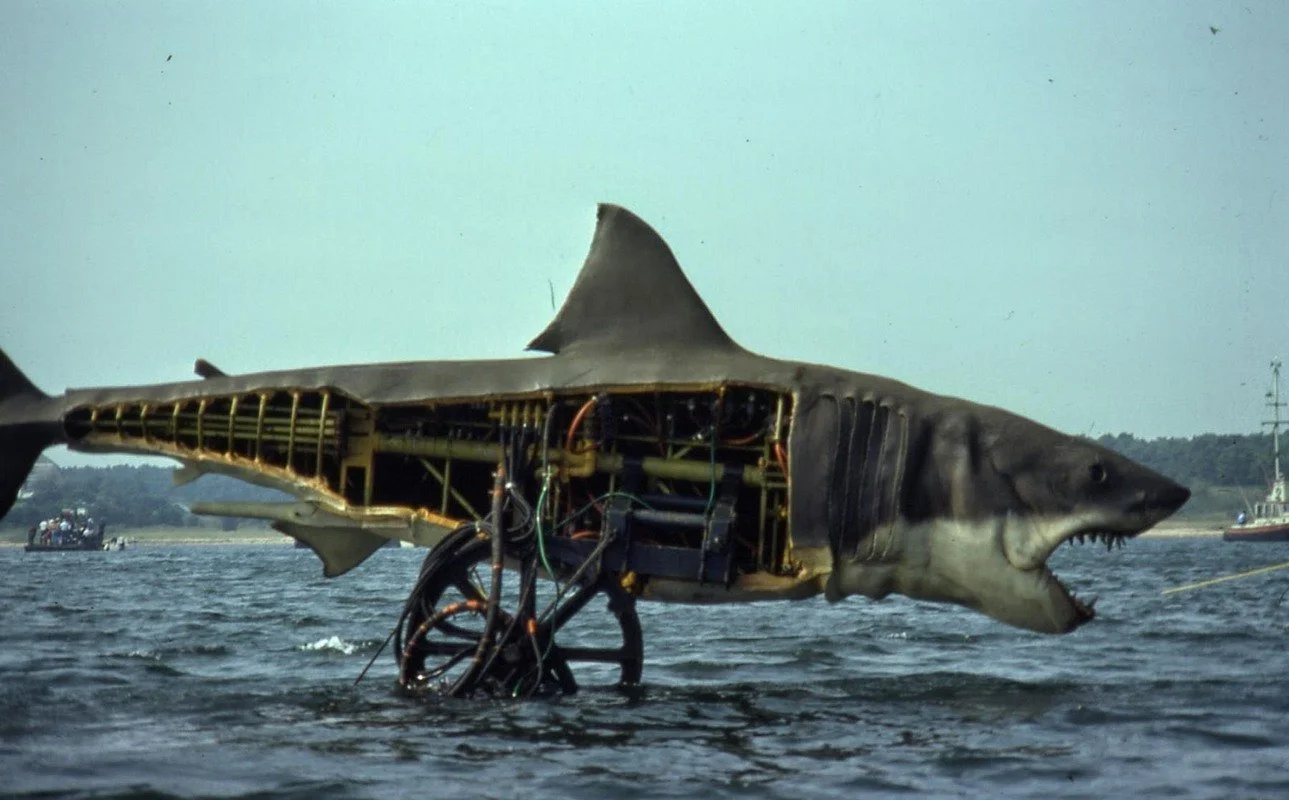
Alves designed the shark while legendary effects technician Bob Mattey supervised construction. Three separate full-scale mechanical sharks were eventually built for the production. (Wikipedia)
The problem?
They had never truly been tested in saltwater.
What followed has become one of the most famous nightmare shoots in movie history. Bruce malfunctioned constantly. Mechanical systems corroded. Sharks sank. Hydraulics failed. Production spiraled over schedule and over budget. Universal executives reportedly considered shutting the film down entirely. (The Times)
Yet Alves never abandoned the illusion.
One of the most misunderstood aspects of the Jaws production is the assumption that the shark’s failures somehow “saved” the movie by forcing Spielberg to hide it. While that is partly true, the hidden genius lies in Alves’ preparation. His storyboards, environmental design, Orca construction, and visual planning gave Spielberg alternatives when Bruce failed. (Architectural Digest)
Without that groundwork, there would have been no movie to salvage.
Even the Orca itself — Quint’s battered fishing vessel — became an extension of Alves’ storytelling philosophy. The boat feels functional, dangerous, cramped, and real because Alves designed it not as a prop but as a character space. The third act’s claustrophobic intensity depends heavily on that production design.
And then there is Bruce himself.
Today the shark can look mechanical to modern audiences raised on CGI, but in 1975 it was astonishing. Alves insisted on anatomical credibility. The shark needed weight, texture, and menace. It had to feel capable of existing in the same physical reality as the actors.
That commitment to realism is why Bruce still works emotionally even when the mechanics show through.
The audience believes the threat.
The Accidental Birth of the Blockbuster
Few people associated with Jaws expected the film to become a cultural earthquake.
Alves himself later admitted he feared audiences might laugh at the shark. During production, the mechanical noises and breakdowns often seemed absurd rather than terrifying. (The Times)
Instead, viewers screamed.
When Jaws premiered in 1975, it changed Hollywood forever. The film became the first true summer blockbuster, rewriting studio distribution strategies and proving that a wide-release event movie could dominate popular culture. (The Times)
Spielberg became a superstar director.
But the visual identity that audiences connected with — Amity, the beaches, the Orca, Bruce himself — came directly from Joe Alves’ imagination and execution.
The irony is remarkable: one of the most influential production designers in movie history helped define blockbuster cinema while remaining largely invisible to the mainstream audience.
That invisibility is often the fate of great production design.
When it works perfectly, viewers accept the world without questioning who built it.
Beyond Jaws
Although Jaws dominates his legacy, Alves’ career stretches far beyond shark-infested waters.
His work on Close Encounters of the Third Kind earned him an Academy Award nomination and a BAFTA win for Best Art Direction. (Wikipedia) The film demanded an entirely different visual language from Jaws: wonder instead of terror, cosmic awe instead of maritime realism.
Yet the same principles applied.
Alves grounded the extraordinary in believable environments. The iconic Devils Tower sequences and the monumental mothership finale feel tangible because Alves approached science fiction with the same architectural logic he brought to Amity Island.
Then came Escape from New York, where Alves designed a decaying Manhattan transformed into a nightmarish prison state. Critics and historians still praise the film’s grimy, “memorably derelict” visual atmosphere. (Wikipedia)
His range was extraordinary.
He could move from small-town Americana to cosmic spectacle to dystopian urban collapse without losing coherence or realism.
That versatility is the hallmark of elite production designers.
Jaws 2 and the Burden of Legacy
Returning for Jaws 2 placed Alves in an impossible position. Sequels to phenomenon films are almost always judged against the impossible standards of the original.
Still, Alves played a major role in shaping the sequel as production designer, second-unit director, and associate producer. (Wikipedia)
He helped redesign the shark technology and maintain continuity with the visual language of Amity. While Jaws 2 never achieved the revolutionary impact of the first film, its craftsmanship and atmosphere remain respected by many fans.
The sequel also revealed how deeply Alves understood the mechanics of suspense filmmaking.
By this point, he was no longer merely designing sets. He was helping orchestrate action itself.
Directing Jaws 3-D
Then came the boldest gamble of Alves’ career.
In 1983, he directed Jaws 3-D during Hollywood’s renewed fascination with 3D cinema. (Wikipedia)
The film’s reputation remains divisive, and Alves himself became an easy target for critics eager to dismiss the sequel. But history has softened some of those judgments.
Viewed today, Jaws 3-D feels less like cynical franchise exploitation and more like an ambitious craftsman experimenting with emerging exhibition technology. Alves approached 3D as a spatial design challenge. He understood environments physically and architecturally, making him uniquely suited to exploring depth-based filmmaking.
Was the film successful artistically?
That depends on the viewer.
But the attempt itself says something important about Joe Alves: he never stopped experimenting.
The Architect of Believability
What truly separates Alves from many production designers is his obsession with physical credibility.
Everything he designed had to function.
The Orca had to move like a real fishing vessel. Bruce had to displace water believably. Amity had to feel inhabited. The mothership in Close Encounters had to seem engineered rather than imagined.
That realism became foundational to the New Hollywood era.
Modern audiences often discuss visual effects separately from production design, but Alves belonged to an era when the disciplines were inseparable. Sets, props, mechanics, lighting, geography, and movement all had to coexist physically in front of the camera.
There was no digital rescue waiting later.
The world either worked — or it didn’t.
The Long-Awaited Recognition
In recent years, appreciation for Alves’ contributions has grown substantially.
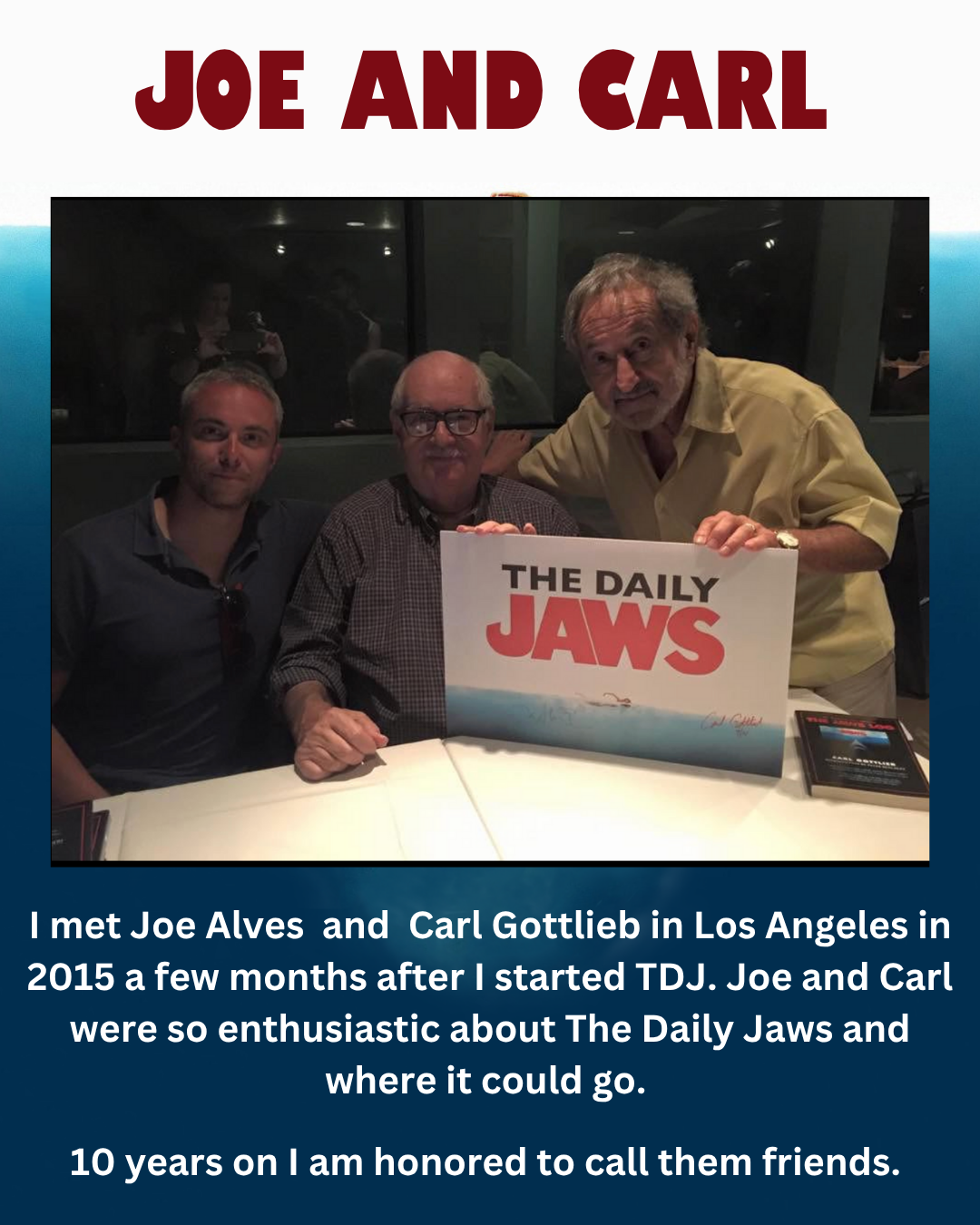
Documentaries, retrospectives, museum appearances, and interviews have increasingly positioned him not merely as “the shark guy,” but as one of the defining visual storytellers of 1970s American cinema. (The Daily Jaws)
His book, Joe Alves: Designing JAWS, offered fans an extraordinary look at storyboards, production illustrations, blueprints, notes, and behind-the-scenes material that revealed just how deeply involved he was in constructing the film’s visual grammar. (The Daily Jaws)
Meanwhile, the documentary Not Your Average Joe aims to chronicle the full breadth of his career and legacy. (The Daily Jaws)
The title feels appropriate.
Because Joe Alves was never average.
Turning 90
As Joe Alves reaches 90 years old this Thursday, his legacy feels more secure than ever.
Fifty years after Jaws, audiences still recognize the silhouette of Bruce emerging from the water. They still remember Amity’s beaches. They still feel the texture of the Orca beneath Quint’s boots.
That is production design at its highest level: not decoration, but memory-making.
Cinema history often celebrates directors, actors, and composers first. But movies are physical dreams, and someone must build those dreams before audiences can enter them.
Joe Alves built some of the most unforgettable dreams — and nightmares — Hollywood has ever produced. (Wikipedia)